how-to
How to Remove Old Pet Stains From Carpet
Table of Contents
- Why Old Pet Stains Are Different From Fresh Accidents
- What You'll Need Before You Start
- Step 1: Identify the Stain and Test for Colorfastness
- Step 2: How to Remove Old Pet Stains From Carpet With Enzymatic Cleaners
- Step 3: How to Neutralize Pet Urine Odor in Padding and Subfloor
- DIY Solutions That Work and Safety Rules to Follow
- When to Choose Professional Carpet Cleaning for Pet Stains
- Conclusion
- Frequently Asked Questions
Last Updated: September 11, 2026
Why Old Pet Stains Are Different From Fresh Accidents
Fresh accidents sit on the surface. Old pet stains have soaked through the carpet fibers, into the padding, and often onto the subfloor, so a quick spray-and-wipe does almost nothing for a stain set for weeks or months.
Pet urine contains uric acid crystals that bond tightly to carpet fibers and padding as they dry (PubMed). They don't dissolve in water alone and reactivate when humidity rises, which is why a "cleaned" spot can suddenly smell again on a warm day.
What You'll Need Before You Start
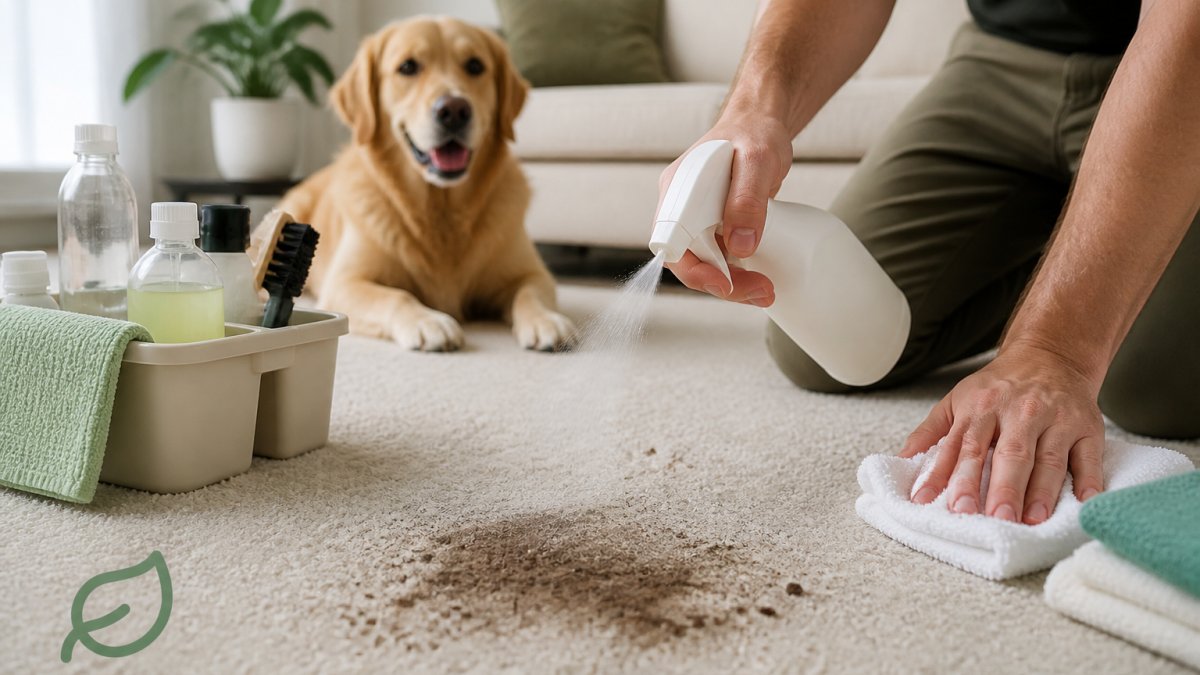
Gather your supplies first:
- Enzymatic cleaner formulated for pet urine
- Distilled white vinegar
- Baking soda
- Hydrogen peroxide (test first, see Step 1)
- Clean white towels or microfiber cloths
- A spray bottle and a soft-bristle brush
- Plastic wrap or a damp towel
- A wet/dry vacuum or carpet shampooer if you have one
Skip paper towels, they shred and leave residue. White cloths show how much pigment is still transferring, which is your progress check.
Step 1: Identify the Stain and Test for Colorfastness
Before any liquid touches the carpet, test colorfastness in a hidden spot: apply a little solution, wait a few minutes, then blot with a white cloth. If color transfers, stop and use a gentler method or call a professional.
Next, identify what you're dealing with:
| Stain Type | Appearance | Best Approach |
|---|---|---|
| Urine (fresh-ish) | Yellow, damp, strong ammonia smell | Enzymatic cleaner |
| Urine (old) | Brown ring, faint or reactivated odor | Enzymatic cleaner plus subfloor check |
| Vomit or feces | Dark, textured residue | Scrape, then enzyme treat |
| Diarrhea | Spread, watery stain | Blot, enzyme treat, repeat |
Synthetic and natural fibers respond differently to peroxide and vinegar. Wool and other natural fibers can be damaged by hydrogen peroxide, so test carefully or avoid it.
Step 2: How to Remove Old Pet Stains From Carpet With Enzymatic Cleaners

An enzymatic cleaner is the most effective tool for old pet stains because it breaks down the uric acid crystals that cause both stain and odor. Unlike vinegar or detergent, enzymes digest the organic material at the source.
Here's how to apply it correctly:
- Blot the area with a clean cloth to remove any loose residue.
- Apply the enzymatic cleaner generously, saturating past the surface.
- Cover with plastic wrap or a damp towel to keep it from drying out.
- Let it dwell for the full time on the label, often several hours for old stains.
- Blot again, then repeat if the stain or odor persists.
Dwell time is the step most people rush, and it matters most.
Step 3: How to Neutralize Pet Urine Odor in Padding and Subfloor
Odor neutralization only works if you treat every layer the urine reached. Urine wicks through the backing into the padding and subfloor and spreads outward, so the wet footprint on the pad is almost always larger than the visible stain. Surface cleaning leaves that reservoir untouched, which is why the smell returns on humid days.
Diagnose how deep the contamination goes
Before committing to a method, figure out which layers are involved:
- The sniff test at the backing. Pull up a corner of carpet at the nearest tack strip and smell the backing and pad directly. If the odor is strong there but faint on the surface, the pad is the source.
- The moisture and stiffness check. Old, dried urine leaves the pad stiff and slightly crusty, and it may show a brown or yellow ring on the underside of the carpet backing.
- The UV check. A UV blacklight flashlight (commonly sold for pet stain detection) makes dried urine fluoresce a yellow-green under a darkened room (PubMed). This reveals the true footprint, including spots you never noticed.
- The subfloor check. If the pad is saturated through, assume the subfloor is too. Concrete and plywood both absorb liquid, and plywood seams and nail heads are common collection points.
Mark the full footprint with painter's tape so you treat the whole area, not just the visible ring.
Treat the padding
For mild saturation, the pad is damp or lightly stained but not crusted, lift the carpet and apply an enzymatic cleaner directly to the pad, not just the carpet face. Work it in with a soft brush, cover with plastic wrap, and let it dwell for the full label time; if the pad dries out mid-dwell, the process stalls.
For moderate saturation, saturate the pad, cover it, and let it dwell longer than the label suggests, often overnight, then extract with a wet/dry vacuum. Repeat until the pad smells neutral when damp, not just when dry. Odor that only appears when wet means the crystals are still there.
For severe saturation, the pad is crusted, discolored through, or the odor is overpowering, replacement is faster and more reliable than cleaning. Cut out the affected section with a utility knife, take it outside, and use it as a template to cut a matching piece of new pad. Pad is inexpensive relative to repeated cleaning, and a fresh section removes the reservoir entirely.
Treat the subfloor
Once the pad is out of the way, treat the subfloor as its own problem:
- Clean. Scrub the area with an enzymatic cleaner or diluted white vinegar, then wipe dry. Do not flood a plywood subfloor, excess moisture can swell and delaminate it.
- Dry completely. Run a fan and, if you have one, a dehumidifier until the subfloor is dry to the touch. Sealing over damp wood traps odor and moisture.
- Seal. Apply a shellac-based or oil-based odor-blocking primer over the cleaned, dry area. These primers form a film that blocks odor molecules from migrating back up; water-based primers are generally less effective. Follow the label's recoat and dry times, and ventilate while it cures.
- Reinstall. Replace the pad section, re-stretch the carpet, and reattach it at the tack strip. If you are not comfortable re-stretching carpet, bring in a pro.
Finishing odor treatment
For light residual odor after the layers are treated, a thin dusting of baking soda left overnight can absorb lingering moisture and smell before you vacuum it up, a finishing step, not a substitute for enzyme treatment. For persistent airborne odor, place bowls of activated charcoal or a commercial odor-absorbing granule in the room; these adsorb odor molecules rather than masking them. Avoid ozone generators in occupied spaces, they are a respiratory irritant, not a substitute for removing the source (the EPA).
DIY Solutions That Work and Safety Rules to Follow
DIY solutions have a real but limited role. Vinegar, baking soda, and hydrogen peroxide can handle light surface residue, deodorize, and lift pigment from some synthetic carpets, but none break down uric acid crystals the way enzymes do. Use them for deodorizing and mild spot treatment, not as your primary fix for old stains.
What each solution actually does
- Distilled white vinegar. Mildly acidic, so it dissolves some mineral and alkaline residue and neutralizes ammonia odor, but it does not digest uric acid crystals. Dilute one part white vinegar to one part water; let it dwell a few minutes, then blot. Rinse with clean water so residue does not attract dirt.
- Baking soda. A mild abrasive and odor absorber. Best as a dry dusting left overnight, then vacuumed, or as a paste for light residue. It does not penetrate to the pad.
- Hydrogen peroxide (3% household strength). An oxidizing agent that can lighten pigment and kill some odor-causing bacteria. It is the most aggressive of the three and the most likely to cause damage. Test first, every time.
- Dish soap. A few drops of mild, dye-free liquid dish soap in warm water is a safe surfactant for lifting residue. Rinse thoroughly, soap residue attracts soil and can cause rapid re-soiling.
Fiber-specific guidance
Carpet fiber determines what is safe. Treating every carpet the same is how DIY attempts turn a stain into permanent damage.
| Fiber | What it is | Safe DIY approach | Avoid |
|---|---|---|---|
| Nylon | Synthetic, resilient, solution-dyed or dyed after | Vinegar solution, mild dish soap, diluted peroxide on light colors after testing | Prolonged peroxide dwell; high heat |
| Polyester (PET) | Synthetic, common in budget carpet | Vinegar solution, mild dish soap, enzyme cleaner | Peroxide can dull or bleach some dyes; strong solvents |
| Olefin (polypropylene) | Synthetic, moisture- and stain-resistant | Mild dish soap, vinegar solution, enzyme cleaner | Oil-based solvents; heat, which can distort fibers |
| Wool | Natural protein fiber | Enzyme cleaner, mild dish soap, cool water; blot, do not scrub | Peroxide, chlorine bleach, ammonia, hot water, agitation, all can felt or yellow wool |
| Triexta (PTT) | Synthetic, often marketed as stain-resistant | Enzyme cleaner, mild dish soap, vinegar solution | Peroxide on darker dyes; abrasive brushing |
If you do not know your fiber, check the manufacturer's label on the carpet backing or the installation paperwork. When in doubt, treat it as wool: cool water, mild soap, blot only.
Safety rules that matter
- Never mix hydrogen peroxide and vinegar in the same container. The combination produces peracetic acid, which is corrosive, can irritate skin, eyes, and airways, and can damage carpet dyes and backing.
- Never mix vinegar or any acid with chlorine bleach. This releases chlorine gas, which is dangerous in an enclosed room.
- Never mix ammonia-containing cleaners with bleach for the same reason. Fresh urine contains ammonia, so do not follow a bleach-based cleaner on a fresh accident.
- Ventilate. Open windows and run a fan when using peroxide, vinegar, or any commercial cleaner.
- Wear gloves and eye protection when handling peroxide or any mixed solution, and keep pets and children out of the treated area until it is dry.
- Do not combine commercial cleaners. Two products that are safe alone can react badly together. Rinse and dry between products.
The lighting trap: how to tell if a stain is gone
A stain can look gone under one light and reappear under another. Before declaring victory, check the spot under three conditions: bright daylight, the room's normal overhead light, and a flashlight held at a low angle across the fibers. Low-angle light rakes across the pile and reveals residue, wicking rings, and flattened fibers that disappear under direct light. If the spot looks clean under all three, let the carpet dry completely, some stains only reappear once dry, and check again. A stain that is truly gone looks the same wet and dry; a bleached spot looks lighter than the surrounding carpet in every light, which is damage, not cleaning.
When to Choose Professional Carpet Cleaning for Pet Stains
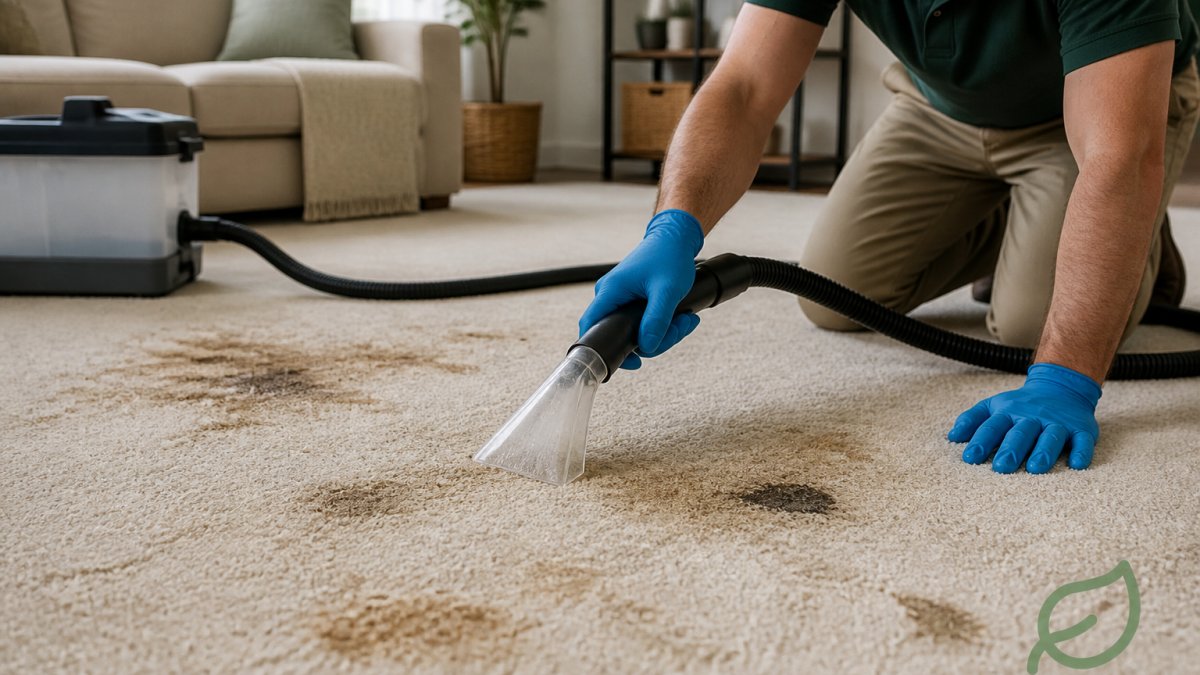
Some stains need equipment and expertise you don't have at home. Professional carpet cleaning for pet stains makes sense when the padding is deeply saturated, the stain covers a large area, or repeated DIY attempts haven't removed the odor.
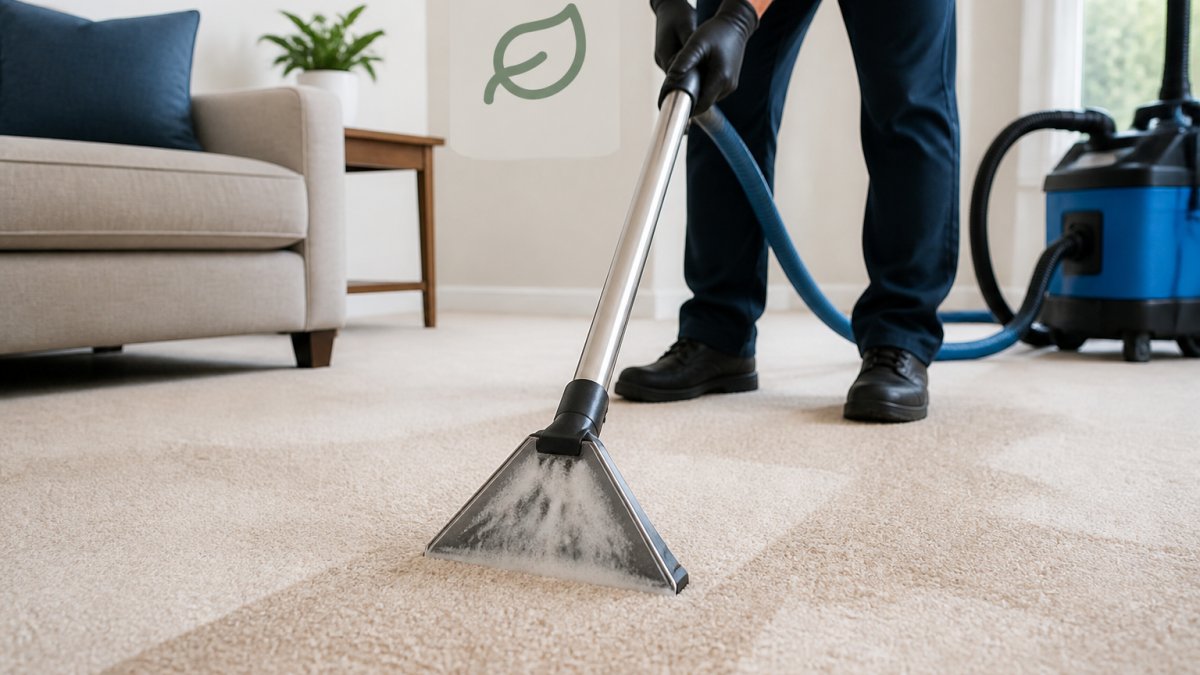
Hot water extraction reaches deeper into carpet fibers and padding than household tools and pulls out residue that blotting leaves behind. For homeowners with allergies, it also removes trapped allergens.
That's the work EcoClean handles across Las Vegas, North Las Vegas, and Henderson. Our team uses hot water extraction and deep cleaning methods to treat carpets, upholstery, and tile and grout, and you can book online without waiting around for a callback.
Conclusion
Old pet stains are a layered problem, and treating only the surface leaves the real cause untouched. If enzyme treatments fail and the smell returns, the contamination is likely in the padding or subfloor, a job for extraction equipment.
EcoClean handles deep pet stain and odor removal with hot water extraction, effective stain removal, and full restoration for carpets and upholstery. Book online with EcoClean.
Frequently Asked Questions
Can old dog pee stains be removed?
Yes, though they take more effort than fresh accidents. Dried urine leaves uric acid crystals that bond to carpet fibers. An enzymatic cleaner breaks down those crystals over a dwell time of 10 to 15 minutes. For stains that have set for months, you may need two or three applications. If the stain has soaked into the padding or subfloor, professional extraction is often the only way to remove it fully.
Will hydrogen peroxide remove old pet stains from carpet?
Hydrogen peroxide can lighten dark stains, but it is a bleach and can strip color from synthetic and natural fibers. Test it on a hidden area first and check for colorfastness. It works best on light-colored carpets when diluted with water. Never mix it with vinegar or ammonia, since that combination creates harmful fumes. For protein-based stains, an enzymatic cleaner is safer and more effective.
How do you remove years of old pet stains from carpet?
Start by blotting and vacuuming loose residue. Apply an enzymatic cleaner generously and let it dwell for at least 15 minutes. Blot with a damp towel, then rinse. If the odor lingers, the urine has reached the padding. Pull back the carpet, treat the pad and subfloor, and replace saturated padding. For stains that keep returning, book professional carpet cleaning for pet stains to extract deep residue.
When should you call a professional for pet stain removal?
Call a professional when the stain has spread beyond the surface, when odor returns after DIY treatment, or when urine has soaked into the subfloor. Signs include a strong ammonia smell on humid days, dark rings that reappear after drying, and visible saturation in the padding. Professional hot water extraction reaches deeper than consumer machines and removes the residue that causes stains to resurface.