 how-to
Does Professional Tile Grout Cleaning Actually Work?
Table of Contents
- Does Professional Tile Grout Cleaning Actually Work?
- How Professional Grout Cleaning Works, Step by Step
- Professional Tile and Grout Cleaning vs DIY
- Realistic Results by Stain Type and Grout Condition
- Tile and Grout Compatibility: Where Cleaning Can Cause Damage
- How Often to Professionally Clean Tile and Grout
- Grout Sealing After Professional Cleaning
- How to Evaluate a Cleaning Provider Before You Book
- Frequently Asked Questions
Last Updated: October 17, 2026
Does Professional Tile Grout Cleaning Actually Work?
Yes, professional tile grout cleaning works, but best on soil, grease, and surface staining. It cannot undo permanent color loss or crumbling grout. Homeowners ask this constantly, and the answer depends on what is actually wrong with the floor.
Professional grout cleaning uses high-pressure hot water, targeted solution, and mechanical agitation to lift embedded soil out of porous grout.
That distinction determines whether you are paying for a real fix or delaying a regrout.
What Professional Cleaning Can and Cannot Fix
The most useful distinction is between soil and damage. Soil sits in the grout. Damage is the grout itself.
Professional cleaning reliably fixes:
- Embedded dirt and grease in grout lines
- Dull, gray film on floor tiles
- Soap scum and body oils in bathrooms
Professional cleaning cannot fix:
- Grout that has crumbled, chipped, or receded below the tile edge
- Permanent dye stains from hair color, wine, or rust
- Efflorescence caused by moisture pushing salts to the surface
A common mistake is booking a deep clean when the real problem is missing grout. If a fingernail catches or crumbles a grout line, cleaning will not help, that floor needs regrouting.
How Professional Grout Cleaning Works, Step by Step
Professional grout cleaning combines heat, pressure, chemistry, and agitation to pull soil out of a porous surface, then extracts it before it resettles.
Here is the process in order:
- Inspection. The technician checks grout condition, tile type, and existing sealant. This step decides the pressure and chemistry used.
- Dry soil removal. Loose dirt and debris get vacuumed or swept up first.
- Chemical dwell time. A grout cleaner is applied and left to break down grease and soil. Dwell time matters more than scrubbing force.
- Mechanical agitation. A brush or pad works the solution into the grout lines.
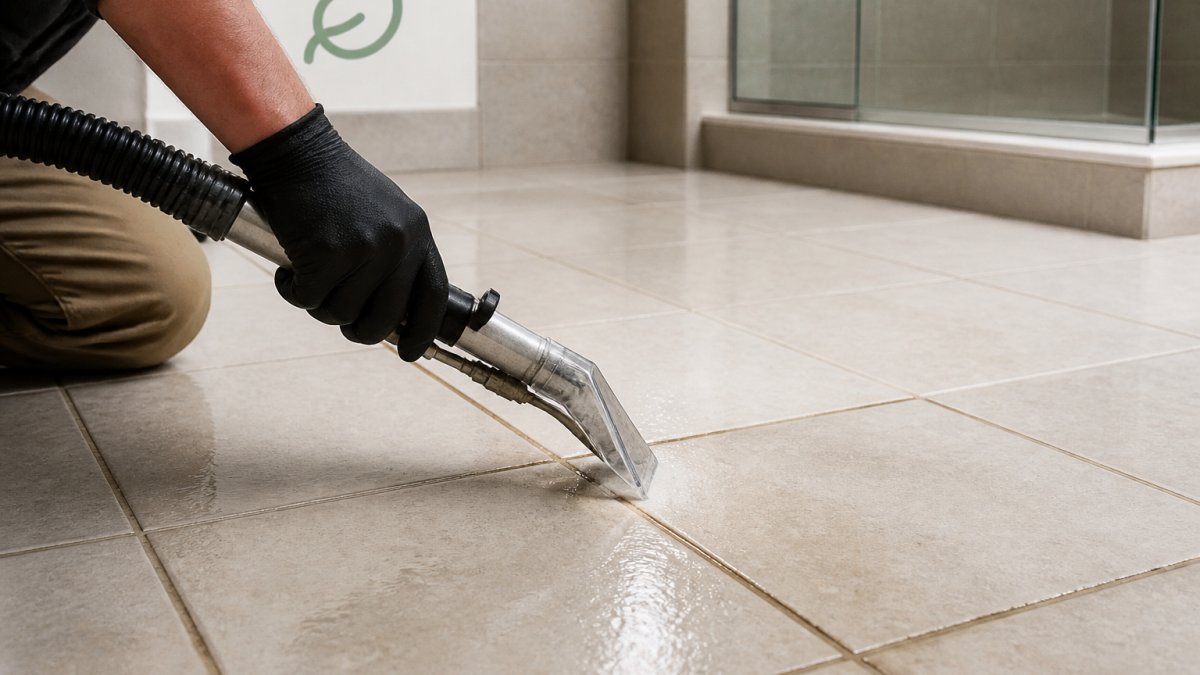
- Hot water extraction. A high-pressure wand flushes the loosened soil and pulls it back into a recovery tank.
- Rinse and inspect. The floor is rinsed and checked under good lighting for missed areas.
- Drying. Air movers speed drying so moisture does not sit in the grout.
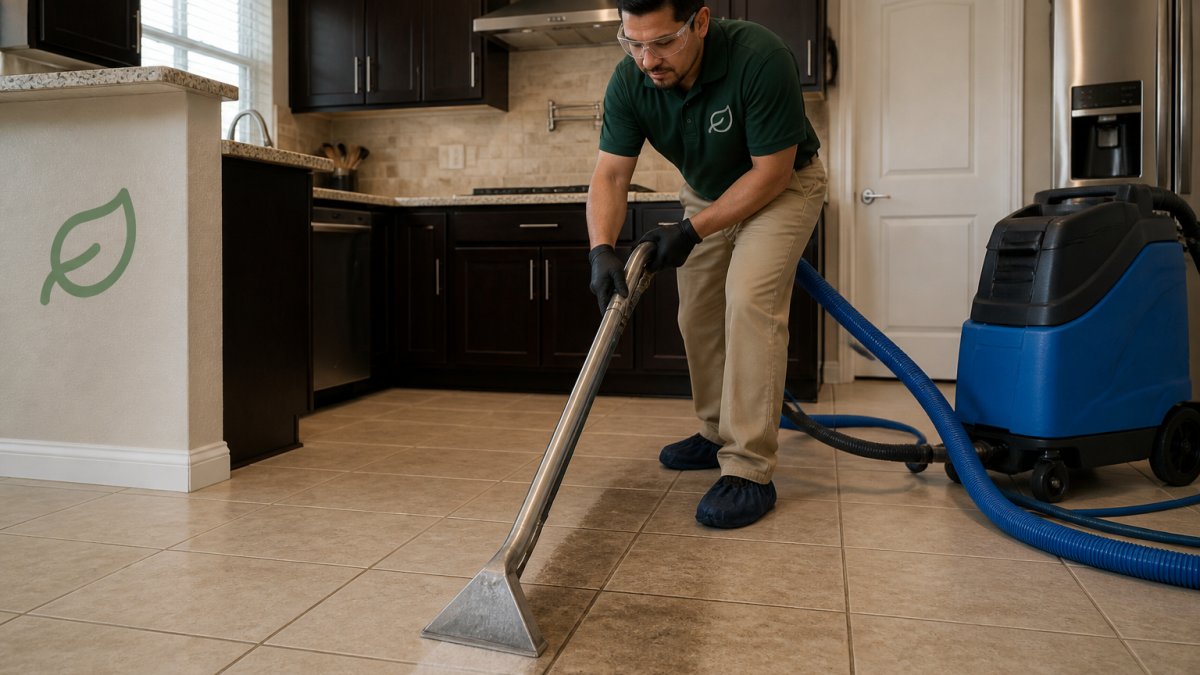
The key difference from mopping is step five. A mop pushes dirty water around. Extraction removes it. That is why professional results hold up longer.
Professional Tile and Grout Cleaning vs DIY
Professional tile and grout cleaning vs DIY comes down to extraction, chemistry, and time. DIY handles maintenance; it struggles with restoration.
DIY works fine for weekly upkeep: a microfiber mop, pH-neutral cleaner, and soft brush keep light soil in check at lower cost.
DIY falls short when soil has bonded. Store-bought grout cleaners sit on the surface and do not extract; you scrub, the water dries, and soil settles back into the same pores.
| Factor | DIY Cleaning | Professional Cleaning |
|---|---|---|
| Best for | Weekly upkeep | Restoration and deep soil |
| Equipment | Mop, brush, spray bottle | Hot water extraction, agitation tools |
| Chemistry | Retail grout cleaner | Commercial-grade, tile-specific solutions |
| Time per room | 30-60 minutes | Handled by the crew |
| Result durability | Fades in weeks | Holds until soil builds again |
| Risk of damage | Low on sealed tile | Managed by inspection first |
Where DIY Cleaning Runs Out of Road
DIY stops working when the problem is inside the grout rather than on it. If you have scrubbed a line three times and it is still dark, more scrubbing will not fix it.
Three signs it is time to call a pro:
- The grout darkens again within days of cleaning
- Scrubbing leaves the grout lighter but still patchy
- You are considering a wire brush or strong acid on tile
That last one is a real risk: harsh acids and aggressive brushes can permanently etch grout and dull tile glaze.
Realistic Results by Stain Type and Grout Condition
Results vary widely by stain type; any provider promising a uniform outcome is overselling. What to expect:
Grease and kitchen soil. Excellent results. Hot water extraction lifts cooking grease well, and grout usually returns close to its original color.
Pet accidents. Good results on surface residue.
Rust. Mixed results. Surface rust lifts. Rust that has bonded to the grout pigment often leaves a shadow.
Dyes, wine, and hair color. Poor to fair. These penetrate the grout and can leave a permanent tint.
Cement haze and efflorescence. Fair. These need specific chemistry and sometimes a second visit.
Grout condition matters just as much.
Tile and Grout Compatibility: Where Cleaning Can Cause Damage
Not every tile tolerates every cleaning method, and this is where cheap work gets expensive. The wrong chemistry or too much pressure can etch a surface, drive water where it should not go, or blow out failing grout.
Why the same method damages different materials
Damage comes from three mechanisms:
- Chemical attack. Acidic cleaners dissolve cementitious grout and etch acid-sensitive stone. Alkaline cleaners can dull some finishes and leave residue if not rinsed.
- Pressure and heat. High pressure can erode soft or failing grout, force water under tile edges, and lift loosely bonded tile.
- Moisture intrusion. Porous materials absorb water. If water gets behind tile or into a substrate that stays wet, it can cause efflorescence, mold, or adhesive failure.
Material-by-material cautions
Ceramic and glazed porcelain. The glaze tolerates most neutral and alkaline cleaners.
Unglazed porcelain and quarry tile. Hard but porous.
Natural stone (marble, travertine, limestone, slate). Porous and often acid-sensitive; marble and limestone etch and dull on contact with acidic cleaners.
Cement-based grout. The most common grout and the most vulnerable to acid.
Epoxy grout. Far more stain- and water-resistant than cement grout, but less tolerant of aggressive mechanical action and some solvents.
Conditions that raise the risk on any tile
- Old or loose grout. High pressure can blow out grout that is already failing.
- Cracked or chipped tile. Water can get under the tile and lift it.
- Failed or yellowed sealant. Cleaning may remove the sealer along with the soil, leaving the grout exposed.
What a careful provider does before treating the floor
A provider should inspect the tile and grout, identify the material and grout type, and test a small, inconspicuous area with the intended chemistry and pressure. A phone quote without looking at the tile is a warning sign.
How Often to Professionally Clean Tile and Grout
Most homes do well with professional tile and grout cleaning every six months to one year, depending on traffic. Commercial spaces and homes with pets usually need the shorter end.
Use this as a starting point:
| Situation | Suggested Frequency |
|---|---|
| Low-traffic bathroom | Once a year |
| Main kitchen with daily cooking | Every 6-12 months |
| Homes with pets or young children | Every 6 months |
| High-traffic commercial floors | Every 3-6 months |
| Entryways and mudrooms | Every 6 months |
Between professional visits, dry mop often, clean spills promptly, and avoid oil-based cleaners that leave residue. Frequency is less about the calendar and more about how fast your grout darkens.
Grout Sealing After Professional Cleaning
Grout sealing after professional cleaning makes the result last. Sealer fills the pores so soil sits on the surface instead of soaking in.
Sealing is not permanent; most sealers need periodic refreshing, and high-traffic areas wear through first.
What sealing does:
- Slows soil absorption
- Makes routine mopping more effective
- Helps stains wipe up instead of setting
What sealing does not do:
- Fix damaged or missing grout
- Make grout waterproof
- Last forever without reapplication
We treat sealing as part of the restoration conversation, not an upsell tacked on at the end. A clean floor that is not sealed will be dirty again sooner.
How to Evaluate a Cleaning Provider Before You Book
The provider matters as much as the process. A good crew inspects, explains, and sets realistic expectations; a bad one quotes fast and promises everything. Here are the questions, paperwork, and cost framework to tell them apart before you pay a deposit.
Questions that separate a real inspection from a phone quote
Ask these in order. A competent provider answers all of them without hedging:
- Will you inspect the floor in person before quoting? Grout condition, tile type, square footage, and existing sealant all change the scope. A firm price given over the phone without seeing the floor is a guess, not an estimate.
- What chemistry and pressure will you use on my specific tile? The answer should name the product type (neutral, alkaline, acidic) and explain why it fits your tile. "We use our standard cleaner" is not an answer.
- How do you handle grout that is cracked, receded, or missing? Cleaning will not fix it, and a good provider says so before the job rather than after.
- Is sealing included, and what sealer do you use? Sealing is often a separate line item. Ask whether the quote includes it, what type of sealer (penetrating versus topical), and how long it is expected to last.
- What will this cleaning not fix? A provider who names the stains that will not fully lift is more trustworthy than one who guarantees a perfect result.
- Can you show before-and-after photos from jobs with my tile and grout type? Generic gallery shots do not count. Ask for a similar material and a similar soil level.
- Are you insured, and can you provide a certificate of insurance? General liability coverage protects you if a wand damages tile or a chemical stains a surface. Ask for the certificate, not just a verbal yes.
- Will you confirm the arrival window and scope in writing? A written estimate should list square footage, rooms, included services, and any exclusions.
What a fair estimate actually contains
A professional estimate is a scope document, not a single number. It should state:
- Square footage and which rooms or areas are covered
- Whether the price includes pre-treatment, agitation, extraction, and rinse
- Whether sealing is included or quoted separately
If two quotes differ widely, compare the scope line by line before comparing the totals. A lower price often excludes sealing, uses less dwell time, or skips the rinse step.
How pricing is typically structured
Professional tile and grout cleaning is usually priced by square footage with a minimum job charge, and sealing is commonly an add-on per square foot. Ask each provider to break the quote into cleaning and sealing so you can compare like with like. Cleaning is typically the larger share, with sealing adding a meaningful percentage on top; the exact split varies by region, accessibility, and soil level.
The decision framework: clean, seal, recolor, regrout, or replace
Use this framework to decide which service you actually need:
| Your situation | Best next step | Why |
|---|---|---|
| Grout is intact but dark, greasy, or filmed | Professional clean, then seal | Soil is the problem; extraction removes it |
| Grout is clean but stains return within weeks | Clean and seal | Unsealed pores are reabsorbing soil |
| Grout color is faded but the surface is sound | Clean, then consider recoloring | Recoloring restores uniform color without removing grout |
| Grout is cracked, crumbled, or receded | Regrout, not clean | Cleaning cannot rebuild missing material |
| Tile is cracked, loose, or stained through the glaze | Replace affected tiles | Surface cleaning cannot fix structural or glaze damage |
A provider who only sells cleaning will often recommend cleaning. One who sells cleaning, sealing, recoloring, and regrouting can tell you which your floor needs. Ask which services they offer, and treat a one-service shop's recommendation with caution.
Red flags
- A firm price over the phone with no inspection or photos
- A guarantee of "like new" results on any grout condition
- No certificate of insurance on request
Frequently Asked Questions
Do grout cleaners really work, or is professional cleaning the only real option?
Store-bought grout cleaners work on surface soil and light discoloration, but they rarely reach the dirt packed into porous grout lines. Professional grout cleaning uses hot water extraction and mechanical agitation to pull embedded soil out rather than just wiping the top layer. If your grout is uniformly dark or has years of buildup, a cleaner alone usually disappoints. If it is only lightly dulled, a grout cleaner followed by sealing can be enough to bring back the original color.
Is professional grout cleaning better than DIY cleaning?
For light maintenance, DIY cleaning with a brush and a grout cleaner is fine. Professional tile and grout cleaning vs DIY comes down to depth: pros use hot water extraction, controlled pressure, and commercial cleaning chemicals that lift soil from deep in the grout lines. DIY scrubbing mostly moves dirt around the surface. Pros also know which tiles and grouts can handle pressure and which cannot, which lowers the risk of damage to floor tiles and grout lines.
Do you have to reseal grout after steam cleaning?
Yes, in most cases. Steam cleaning and hot water extraction open the pores of the grout and strip away old sealer along with the soil. Without a fresh coat of grout sealer, the grout absorbs spills and dirt faster than before. Grout sealing after professional cleaning is what protects the results, usually applied once the floor is fully dry. Ask your provider whether sealing is included or priced separately so there are no surprises.
How often should tile and grout be professionally cleaned?
For most homes, professional tile and grout cleaning every 12 to 18 months keeps grout lines from darkening permanently. High-traffic areas like kitchens, entryways, and bathrooms may need cleaning every 6 to 12 months, especially with pets or children. Commercial spaces often run on a 6-month schedule. If you notice grout color fading or stubborn stains returning within weeks of a DIY scrub, that is a sign it is time to book a professional estimate.