 listicle
7 Natural Carpet Stain Removers for Tough Spots That Work
Last Updated: November 4, 2026
Quick Summary
The best natural carpet stain removers for tough spots match the cleaner to the fiber: plant enzymes for organic and pet stains, oxygen cleaners for old set-in color stains, and citrus concentrates for deep cleaning. Blot, never scrub, and avoid over-wetting so stains do not reach the backing.
- Folex is a water-based, odorless surfactant spray that needs no rinsing or vacuuming afterward.
- Enzyme cleaners need dwell time and a damp area, since spraying and immediately blotting wastes the product.
- Oxygen spot formulas usually call for 5 to 15 minutes of dwell time; powdered percarbonate needs 10 to 30 minutes.
- For baking soda, sprinkle it over the stain, spray white vinegar on top, and let it sit ten to fifteen minutes.
- Avoid alkaline oxygen cleaners, hot water, and prolonged wetting on wool, which is an acidic protein fiber.
Table of Contents
- Quick Comparison: 7 Natural Carpet Stain Removers for Tough Spots
- How We Evaluated These Natural Stain Removers
- 1. Folex Carpet Spot Remover: Fastest Lift for Fresh Spills
- 2. Naturally It's Clean: Enzyme Power for Organic Stains
- 3. Biokleen Carpet & Rug Shampoo: Citrus Concentrate for Deep Cleaning
- 4. How to Remove Old Hard Set Carpet Stains with Oxygen Cleaners
- 5. How to Get Old Stains Out of Carpet with Baking Soda
- Natural Carpet Stain Remover Safety Tips for Every Fiber
- Frequently Asked Questions
Quick Comparison: 7 Natural Carpet Stain Removers for Tough Spots
Most natural carpet stain removers for tough spots fail for one reason: they treat every fiber the same. Wool, nylon, and polyester hold stains differently, and a remover that lifts red wine from synthetic carpet can set it permanently into wool. This guide breaks down seven plant-based and oxygen-based options, what each does best, and where DIY attempts usually go wrong. Understanding these material distinctions remains equally critical when addressing spills on furniture, which is why natural upholstery stain removers require a similarly tailored approach to avoid damaging delicate fabric weaves.
Here is the short version before the detail:
| Remover | Best For | Starting Price | Key Ingredient |
|---|---|---|---|
| Folex Spot Remover | Fresh spills, speed | $6.65 | Water-based surfactant |
| Naturally It's Clean | Pet and food stains | $7.95 | Plant enzymes |
| Biokleen Shampoo | Deep cleaning, large areas | $12.99 | Citrus extracts |
| OxiClean Spot Remover | Old set-in stains | $5.99 | Oxygen bleach |
| Bissell Stain & Odor | Pet odors | $8.99 | Enzyme formula |
| Bissell Pro Oxy Power | Coffee and wine | $7.49 | Oxy surfactants |
| Rocco & Roxie | Recurring pet accidents | $19.97 | Bio-enzymatic |
A quick word on safety before you spray anything. The EPA Safer Choice program screens cleaning products for ingredients that pose health or environmental risks, and it is a reasonable filter when you are buying for a home with kids or pets.
How We Evaluated These Natural Stain Removers
Enzyme cleaners need moisture and time to work. Spraying and immediately blotting wastes the product. A common mistake is soaking the spot, which pushes the stain deeper into the backing and can damage the backing itself.
1. Folex Carpet Spot Remover: Fastest Lift for Fresh Spills
Folex is a water-based, odorless surfactant spray that lifts stains from carpet fibers without rinsing or vacuuming afterward.
The tradeoff: very old, set-in stains often need two or three applications. It is safe on colorfast carpets and upholstery, but test an inconspicuous corner first on anything hand-dyed.
Best for: households that want a fast, no-rinse spray on standby. Skip if: you are fighting a stain that has been there for months.
2. Naturally It's Clean: Enzyme Power for Organic Stains
Plant-derived enzymes break organic matter down at the source, which makes this type of cleaner suited to food, wine, coffee, and pet accidents.
Enzymatic action is slow by design. Give it dwell time, keep the area damp, and let the enzymes finish the job. This is also the better choice when odor lingers, because enzymes attack the residue that causes smell rather than masking it.
Best for: eco-conscious homes dealing with organic stains. Skip if: you need the stain gone in the next five minutes.
3. Biokleen Carpet & Rug Shampoo: Citrus Concentrate for Deep Cleaning
Grapefruit seed and orange extracts do the cleaning here, with no artificial fragrances or colors. It is a concentrate, so dilute it before use, and one bottle covers a lot of square footage.
This is a whole-area option rather than a spot spray. For high-traffic lanes and dull patches, dilute, apply, agitate gently, and extract.
Best for: deep cleaning larger areas with plant-based ingredients. Skip if: you want a grab-and-go spot treatment.
4. How to Remove Old Hard Set Carpet Stains with Oxygen Cleaners
Oxygen-based cleaners lift old hard set carpet stains by oxidation: the active oxygen species (typically hydrogen peroxide or sodium percarbonate released in water) attacks the conjugated double bonds that give a stain its color, breaking the chromophore apart so the residue can be rinsed away.
Here is the sequence that works:
- Vacuum loose debris from the spot, then blot any liquid still sitting on the surface.
- Test the product on a hidden patch (under a sofa, inside a closet) and let it dry fully, dye damage often shows only after drying.
- Apply the oxygen solution at label dilution and let it dwell for the full label time. Most ready-to-use spot formulas call for 5-15 minutes; powdered percarbonate mixes usually need 10-30 minutes.
- Blot with a white microfiber cloth, working from the outside in so you do not spread the stain.
- Rinse with clean water and blot dry, then weight a dry towel over the spot so the pile dries flat.
- Repeat once if the stain is still visible after drying, but not more.
Watch out: oxygen cleaners can lighten wool, silk, and some natural-fiber dyes, and they should never be mixed with vinegar or other acids, the acid neutralizes the peroxide before it finishes working and can leave a sticky residue in the pile.
Which oxygen product fits which fiber. Solution-dyed nylon and polyester tolerate standard 3% hydrogen peroxide spot formulas well. Wool, wool blends, and viscose/rayon need a pH-neutral oxygen product or none at all; alkaline boosters swell wool scales and cause felting. Unknown fibers get the patch test, always. If the label lists sodium percarbonate as the active and you are on wool, stop and use an enzyme product instead.
Why old stains resist. A stain that has been through a hot-water extraction or a steam clean without full rinsing can be locked in by the heat, and no oxygen product will fully lift it. In that case the fiber has been dyed by the spill, not coated by it, and the fix is a reducing agent or professional treatment, not more peroxide.
5. How to Get Old Stains Out of Carpet with Baking Soda
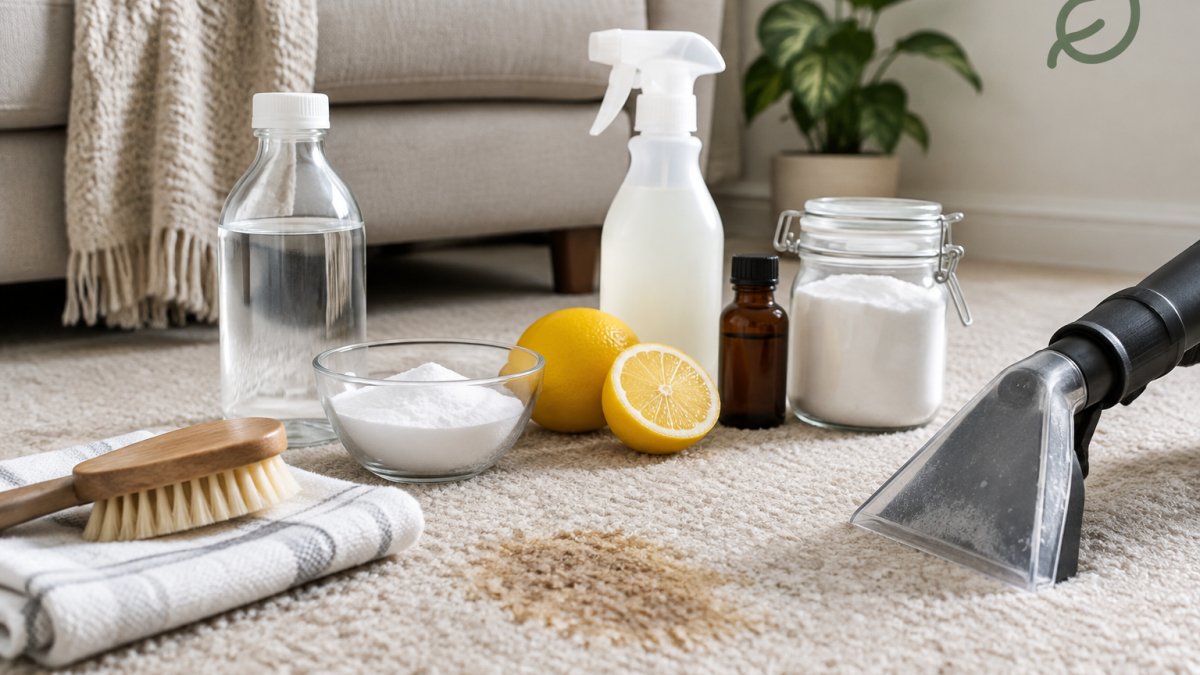
To get old stains out of carpet with baking soda, you combine it with white vinegar: the fizzing lifts grime from the carpet pile while the baking soda absorbs odor. It costs almost nothing if both are already in the pantry.
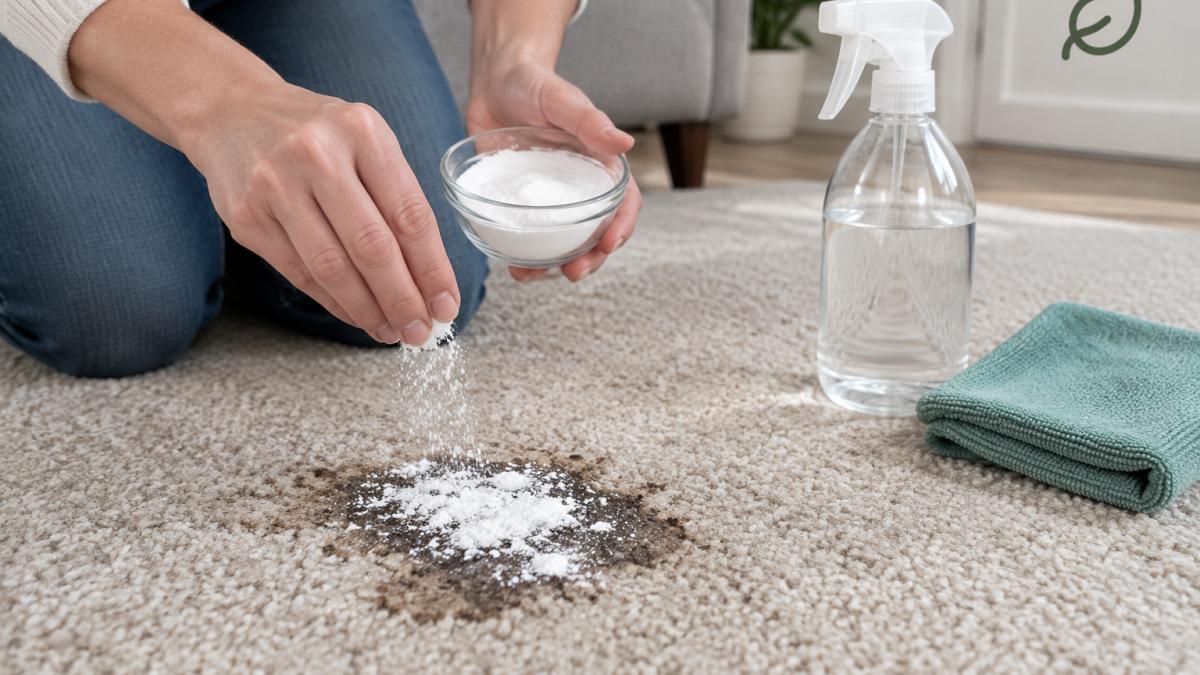
Sprinkle a generous layer over the stain, spray white vinegar on top, and let it sit for ten to fifteen minutes. Blot, then vacuum once dry. It handles mild stains well. Extremely old, set-in stains usually need an oxygen or enzyme product instead. If the stain returns after a few days, the residue was never fully extracted, and our guide on why carpet stains reappear after cleaning explains the cause.
Natural Carpet Stain Remover Safety Tips for Every Fiber
Match the cleaner to the fiber before anything else. The single most useful thing you can know about a carpet is what it is made of, because the same vinegar spray that rescues a nylon berber can dull a wool loop and set a stain into a polyester cut pile. The table below is the compatibility framework most guides skip.
| Fiber | Safe natural cleaners | Use with caution | Avoid |
|---|---|---|---|
| Wool | pH-neutral enzyme cleaners, cool water, white vinegar at 1:4 dilution | Oxygen boosters only if labeled wool-safe; test first | Alkaline oxygen cleaners, hot water, chlorine, prolonged wetting |
| Nylon (solution-dyed) | Vinegar solutions, enzyme cleaners, oxygen spot sprays, baking soda | Strong acids on older nylon; test dye stability | Chlorine bleach, solvent-heavy degreasers |
| Polyester | Vinegar, enzyme cleaners, oxygen spot sprays, dish-soap solutions | High-pH cleaners on dark dyes | Acetone, nail polish remover, hot water extraction on set-in oil |
| Olefin (polypropylene) | Water-based surfactants, enzyme cleaners, vinegar | Oil-based solvents (olefin is oil-loving and can wick) | Solvent cleaners, heat |
| Triexta (PTT) | pH-neutral enzyme cleaners, oxygen spot sprays | Vinegar at full strength on prolonged contact | Chlorine, high-alkaline shampoos |
| Viscose/rayon | pH-neutral enzyme cleaners only, minimal water | Any oxygen product | Water-heavy soaking, agitation, alkaline cleaners |
| Unknown | Patch test in a hidden area, then enzyme cleaner | Anything else | Everything until tested |
Why pH matters more than the label. Wool is an acidic protein fiber; alkaline cleaners (pH above roughly 8) swell the scales and cause felting and dulling. Nylon and polyester are more tolerant but can be dyed by strong acids left too long. Vinegar at full strength is around pH 2-3, which is why it works on nylon but should be diluted before it touches wool.
A few rules that prevent most damage:
- Blot, never scrub. Scrubbing distorts the carpet pile and spreads the stain into the backing.
- Avoid over-wetting. Saturation reaches the backing and causes recurring stains, delamination, and odor.
- Keep hydrogen peroxide off wool and dark-dyed synthetics unless the label says otherwise.
- Ventilate the room. Even plant-based products release some volatile organic compounds.
- Store products out of reach of children and pets, and never transfer them out of their original containers.
Watch out: if a DIY attempt leaves a sticky residue or a ring, stop adding product. Layering cleaners can set the stain or damage the fiber, and the residue itself attracts dirt and causes the stain to reappear. Our professional carpet cleaning services use hot water extraction to flush residue the vacuum cannot reach, and our blog covers which harsh chemicals to avoid on carpet when you are choosing a store-bought product. For a local shortlist, see the best non-toxic carpet cleaners guide.
Frequently Asked Questions
What is the most effective homemade carpet stain remover?
A white vinegar and baking soda paste handles most fresh spots: blot the stain, apply a 1:1 vinegar-water spray, sprinkle baking soda, let it fizz for 5-10 minutes, then blot and rinse. For set-in organic stains like pet accidents, an enzyme-based cleaner often works better because enzymes break down the proteins baking soda cannot. Match the method to the stain type rather than relying on one recipe for everything.
Are natural carpet stain removers safe for all carpet fibers?
Not automatically. White vinegar is acidic and can dull wool and other natural fibers over time, while hydrogen peroxide can bleach darker dyes. Always check colorfastness on a hidden patch first, keep the area ventilated, and avoid over-wetting so moisture does not reach the backing. Natural fiber carpets such as wool and sisal need pH-neutral, low-moisture treatment, while most synthetic carpets tolerate vinegar and oxygen cleaners well.
Does hydrogen peroxide remove carpet stains without discoloration?
Hydrogen peroxide lifts organic stains like blood and wine through oxidation, but it is a mild bleach and can lighten dyed carpet if left too long. Mix 3% peroxide with water, test on an inconspicuous spot, and limit dwell time to a few minutes. Rinse thoroughly with clean water and blot dry. On dark or wool carpets, choose an oxygen-based cleaner labeled color-safe instead.
Can baking soda and vinegar remove set-in carpet stains?
They work best on fresh or lightly set stains. For older stains, pretreat with the vinegar spray, let it sit for 10 minutes, apply the baking soda paste, and leave it up to an hour before vacuuming. If the stain has been there for months, the residue has bonded to the fibers and a professional hot water extraction clean is usually the only way to lift it fully.
How do you handle tough spots that keep coming back after DIY cleaning?
Recurring spots usually mean residue was left in the carpet or the stain reached the backing or pad. Rinse the area with clean water and blot until no soap remains, then dry it completely with a fan. Pet stains that return often carry pheromones, so use an enzyme cleaner that eliminates them. If the spot still reappears, the padding beneath may be saturated and needs professional extraction.
Tough spots that keep coming back usually mean residue is still in the backing, not that your technique failed. EcoClean removes that residue with hot water extraction and eco-friendly solutions, safe for homes with pets and children across Las Vegas, North Las Vegas, and Henderson. Book online and get a confirmed arrival window, so you are not waiting around all afternoon. Get started with EcoClean and see the stain gone for good.