 blog
blog
Carpet Cleaning Services Las Vegas Reviews: 2026 Guide
Table of Contents
- What Carpet Cleaning Services Las Vegas Reviews Actually Reveal
- Steam Cleaning vs. Dry Cleaning: Which Method Wins in the Desert
- Professional Carpet Cleaning Cost: What Drives the Price
- How to Choose a Carpet Cleaning Company
- How Long Does Carpet Cleaning Take?
- Pet Stains, Allergies, and Eco-Friendly Solutions
- DIY vs. Professional Maintenance Schedules
- Frequently Asked Questions
Last Updated: September 13, 2026
What Carpet Cleaning Services Las Vegas Reviews Actually Reveal
Carpet cleaning services Las Vegas reviews reveal more about reliability and honesty than cleaning power. The same complaints repeat: late technicians, quotes that double at the door, and stains that reappear within weeks. These patterns shape how we approach every job across the Las Vegas Valley.
The desert makes carpet care harder here. Fine dust settles deep into fibers, and dry air bonds soils to the backing. Reviews mentioning "stains came back" usually describe wicking: residue in the pad rising to the surface after drying.
Below: what reviews measure, which method suits desert homes, and how to read a quote before booking.
Steam Cleaning vs. Dry Cleaning: Which Method Wins in the Desert
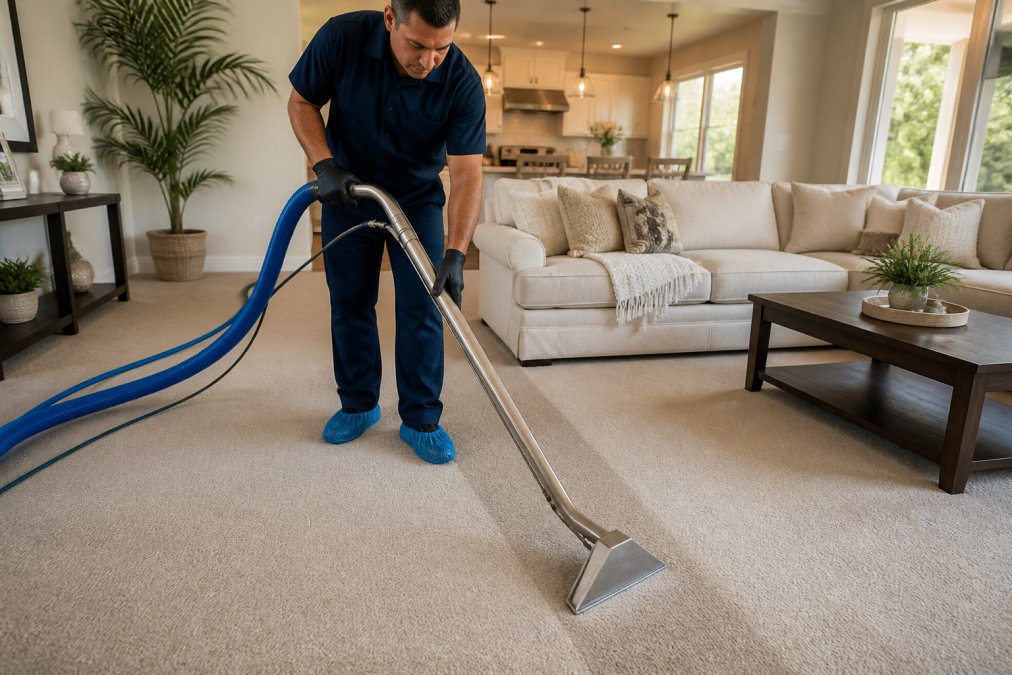
Hot water extraction, or steam cleaning, is the better choice for most carpets here. It flushes embedded dust and allergens out of the fiber rather than spreading them, which matters when fine desert particulate is the main soil.
Dry cleaning uses far less moisture and suits quick touch-ups, low-pile commercial carpet, and delicate fabrics. For a family home with pets and heavy traffic, though, dry methods rarely reach the bottom third of the pile where dust accumulates.
The trade-off is drying time; proper moisture control leaves carpet damp, not soaked.
Hot Water Extraction and Drying Times
Most carpets dry within 4 to 8 hours with proper extraction passes and air movers; humidity, carpet thickness, and airflow shift that window (iicrc.org).
Over-wetting is common: too much water saturates the pad, causing odor and delamination. Ask providers how they control moisture, and listen for multiple dry passes, airflow management, and moisture readings before they leave.
Professional Carpet Cleaning Cost: What Drives the Price
Professional carpet cleaning cost depends on square footage, soil level, fiber type, and add-ons, not a flat rate. Any quote given before someone sees the carpet is a guess, and most published prices are "starting at" figures that tell you nothing. Here is how the number is built.
How the Price Is Built
Almost every provider prices one of two ways:
- Per room, with a size cap (commonly about 200 square feet). Rooms over the cap bill as additional rooms or by square foot.
- Per square foot, usually in tiers that drop as area rises. Stairs, landings, and closets are priced per step or as a flat add-on.
Per-room quotes compare easily; per-square-foot quotes are more accurate for open floor plans, where a "living room" may be 400 square feet. Ask each provider to quote the same way so numbers line up.
What Actually Moves the Number
| Cost Factor | Why It Changes the Price | How It Is Usually Billed |
|---|---|---|
| Square footage | More area means more labor and solution | Per room (with a size cap) or per sq ft in tiers |
| Soil level | Heavy traffic lanes and embedded desert dust need pre-treatment and extra passes | Added pre-treatment charge per room |
| Fiber type | Wool, sisal, and delicate blends need gentler chemistry and lower heat | Specialized handling fee |
| Pet treatment | Odor neutralization must reach the pad and sometimes the subfloor | Separate line item, often priced per affected area |
| Stairs and landings | Slow, hand-detailed work | Per step or flat add-on |
| Furniture moving | Time and liability | Per item or per room |
| Add-ons | Upholstery, tile and grout, area rugs, air ducts | Quoted individually |
Reading a Quote Without Getting Surprised
A trustworthy quote names the method, rooms or square feet, pre-treatment, and every add-on in writing before the technician arrives. A low headline number alone is incomplete by design.
Three questions separate a real quote from a teaser:
- Is the price per room or per square foot, and what is the room size cap? Vague answers mean the price changes on arrival.
- Is pre-treatment included or an upcharge? Desert traffic lanes and entryways almost always need it.
- What triggers an add-on, and what does each cost? Pet treatment, stairs, and furniture moving are the most common surprises.
A Practical Way to Budget
Rather than chase a national average, build your own estimate:
- Count rooms, noting any over the provider's size cap.
- Add pre-treatment for each high-traffic area (entry, hallway, living room).
- Add pet treatment for each area with odor or staining, not just the visible spot.
- Add stairs, furniture moving, and upholstery or tile work as separate lines.
That total is what to compare across bids, not the headline rate. Request a written quote based on room count or square footage rather than accepting a phone estimate.
How to Choose a Carpet Cleaning Company
To choose a carpet cleaning company, verify three things before booking: licensing and insurance, a written quote with no surprise fees, and a guarantee covering reappearing stains.
Read reviews critically, looking for patterns rather than single complaints. A provider with a few one-star reviews about lateness is a different risk than one with repeated reports of damaged carpet or bait-and-switch pricing.
The guarantee matters more than the discount: a stain returning after two weeks is a warranty claim, not a new job. Ask what happens if it does.
Questions to Ask Before You Book
- Are you licensed and insured, and can I see proof?
- Is the quote fixed, or can it change on arrival?
- What method do you use, and how long will carpet stay damp?
- Do you pre-treat high-traffic areas and pet spots?
- What does your guarantee cover, and for how long?
- Can I see before-and-after photos from similar jobs?
How Long Does Carpet Cleaning Take?
How long does carpet cleaning take? Plan on 20 to 30 minutes per room, so a three-bedroom home runs 2 to 3 hours including setup and drying preparation.
Several factors stretch that timeline:
- Heavy soiling or years since the last cleaning
- Furniture moving, which adds time per room
- Pet treatment, which requires extra dwell time
- Tile and grout or upholstery added to the same visit
Same-day service suits smaller jobs; larger homes and commercial spaces need scheduling. Ask for a time window, not just a day, and whether the technician calls ahead.
Pet Stains, Allergies, and Eco-Friendly Solutions
Pet odor neutralization is a different job from stain removal, and treating them alike is why odors return. Urine soaks through carpet into the pad and sometimes the subfloor; surface cleaning removes the visible stain, but the smell returns as humidity releases the residue. That mechanism matters more in a dry climate than anywhere else.
Why Pet Odor Comes Back
Urine contains uric acid crystals that bind to carpet fiber, pad, and subfloor. They are not water-soluble, so standard hot water extraction wets them without breaking them down. When humidity rises, a monsoon week, a spilled glass, a humidifier, the crystals release odor again, which is why a carpet can smell clean for two weeks and then "reappear."
The fix is chemistry, not more water. Enzyme-based neutralizers consume the uric acid crystals and surrounding organic matter. They need dwell time, typically 10 to 30 minutes depending on concentration and soil load, and must reach the same depth the urine did. If the pad is saturated, it has to be flushed or, in severe cases, replaced.
A Step-by-Step Protocol
A thorough pet treatment follows a sequence. Ask any provider to walk you through theirs:
- Locate every deposit, not just the visible stain. Urine spreads laterally under the carpet. A UV or blacklight inspection reveals the full affected area, which is often two to three times the size of the visible spot.
- Pull back the carpet if the pad is saturated. Surface-only treatment on a soaked pad is wasted money.
- Flush the pad and subfloor. Extraction at the pad level removes the bulk of the contamination before any neutralizer is applied.
- Apply an enzyme-based neutralizer and let it dwell. Skipping dwell time is the single most common reason a pet odor reappears.
- Extract, then dry aggressively. Air movers and dehumidification prevent the moisture from becoming its own odor problem.
- Re-inspect after drying. Odor that persists after a full dry-down usually means the subfloor was affected and needs sealing.
Desert-Specific Allergen Load
Fine desert particulate, dust, pollen, and mineral grit from spring and monsoon season, settles deep into carpet pile and bonds to the backing in low humidity. For households managing allergies or asthma, that trapped load is the real target, not visible soil. Hot water extraction at proper temperature and dwell time flushes it out rather than redistributing it into the air.
A few practical habits help between professional visits:
- Vacuum with a HEPA-filter machine two to three times a week during high-dust periods (the EPA).
- Change HVAC filters on schedule; a clogged filter recirculates what the carpet just released.
- Keep entry mats at every exterior door to capture grit before it reaches the carpet.
Eco-Friendly and Pet-Safe Solutions
Many families choose non-toxic solutions so children and pets can return once the carpet is dry. "Green" and "pet-safe" are unregulated terms, so ask specifically:
- What product is used, and is it enzyme-based or a masking agent? Masking agents cover odor temporarily; enzymes eliminate it.
- Is a residue left behind? Some detergents leave a sticky film that attracts new soil. A rinse or pH-balancing step prevents that.
- What is the dry time, and when is the room safe for pets? Most pet-safe solutions are safe once the carpet is dry, not before.
If eco-friendly solutions matter to you, ask whether they are standard or an option, and get the answer in the written scope alongside the price.
DIY vs. Professional Maintenance Schedules
A practical plan combines DIY spot treatment between visits with professional deep cleaning on a schedule matching your household.
| Household Type | DIY Frequency | Professional Frequency |
|---|---|---|
| No pets, adults only | Spot clean as needed | Every 12 to 18 months |
| Kids, light traffic | Weekly vacuum, spot clean | Every 9 to 12 months |
| Pets or allergies | Spot clean immediately | Every 6 to 9 months |
| Rentals and high traffic | Vacuum twice weekly | Every 4 to 6 months |
DIY machines handle surface soil and fresh spills but cannot extract from the pad and often leave excess moisture. Professional hot water extraction reaches the layer DIY tools miss, protecting carpet longevity and postponing replacement.
For property managers and vacation rental hosts, a recurring maintenance plan keeps turnover predictable. Learn more about scheduling on our Institute of Inspection, Cleaning and Restoration Certification standards page, which outlines recognized cleaning practices.
Carpet that looks clean and carpet that is clean are two different things, and the gap shows up months later as returning stains and odors. EcoClean handles carpet, upholstery, and tile and grout cleaning for homes and businesses across Las Vegas, North Las Vegas, and Henderson, using hot water extraction and deep cleaning methods built for desert soil and pet damage. Booking online takes a few minutes, and you get a written scope before anyone arrives. Get started with EcoClean and schedule a deep clean that holds up past the first week.
Frequently Asked Questions
How much does professional carpet cleaning cost in the area?
Pricing depends on square footage, carpet condition, and the number of rooms you need cleaned. Most providers quote per room or per square foot, and add-ons like pet odor neutralization or upholstery cleaning raise the total. Request a written estimate that itemizes each service before you book so there are no surprises on the day of the job.
How often should I have my carpets professionally cleaned?
For most homes, once every 12 to 18 months is enough. Households with pets, kids, or allergy sufferers should schedule deep cleaning every 6 to 12 months. High-traffic areas like entryways and hallways benefit from spot treatment between visits. A maintenance plan keeps carpet longevity up and prevents soil from grinding into the fibers.
Do professional carpet cleaners remove pet stains and odors?
Yes, when the technician uses the right protocol. Pet accidents soak through the carpet into the pad and subfloor, so surface cleaning alone will not stop the smell from returning. A proper treatment includes enzyme-based pre-treatment, hot water extraction, and pet odor neutralization at every layer. Ask the provider to confirm their pet-specific process before booking.
How long does it take for carpets to dry after professional cleaning?
Most carpets dry in 4 to 6 hours with good airflow, though humidity and carpet thickness can push it to 12 hours. Running ceiling fans, opening windows, and turning on the air conditioning speeds things up. Avoid walking on damp carpet in street shoes, and keep pets off the area until it is fully dry to prevent re-soiling.